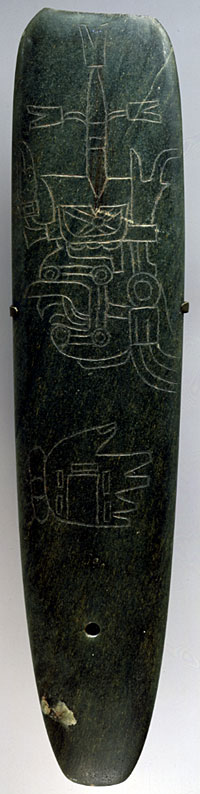
| The potency of maize as a symbol of wealth is appparent by the Middle Formative period (900-400 BC), when greenstone celts, symbolizing maize plants were adorned with trefoil emblems emerging from the cleft heads of supernatural beings (Fields 1982; 1991). The trefoil defines the figure on this celt (right) as the Olmec Maize God (Taube 1996).
Fields, Virginia M. 1982. "Political Symbolism among the Olmec." Manuscript on file, Departement of Art and Art History, University of Texas at Austin.
(left)
|
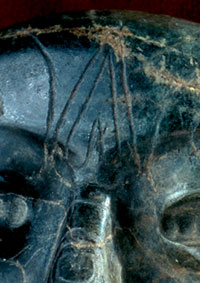
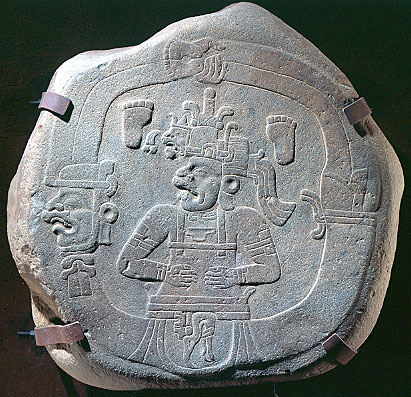
Carved Altar. | This altar, reportedly found near San Antonio Suchitepéquez, features one of the most complex scenes of the well-known Mesoamerican acrobat figure. Here, a simply dressed man forms the circular border by grasping his ankles. The same man is also shown frontally, his feet arched over his head, dressed as the Olmec Maize God (Taube 1996, 50). He wears the trefoil emblem atop his head, a tasseled ear of corn, and quetzal plumes. On his chest is a so-called spoon, which he possibly used to ingest hallucinogens that allowed him to enter into a trance state and manifest as the Maize God. The crested raptor head hanging from the frontal figure's waist acts as the point of articulation between the two representations.
Shook, Edwin M. and Robert F. Heizer. 1976. "An Olmec Sculpture from the South (Pacific) Coast of Gautemala." Journal of New World Archaeology 1 (3): 1-8. |
Copyright 2005 Los Angeles County Museum of Art